|
|
|
|
|
Cities need freedom to tax income June 23, 2025
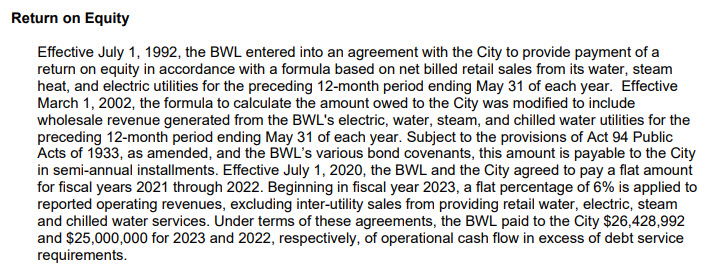
A big hunk of the revenue the City of Lansing's uses to balance its budget is a payment from the Board of Water & Light. In his June 15 story, mayoral candidate Brett Brockschmidt says the latest payment was $26,237,421. The BWL calls it "return on equity" and describes it in its 2023 Financial Report (page 34) as follows:
Brockschmidt says it comprises 17% of the Lansing's revenue stream and is roughly equivalent to the cost of the police department. It is a back door tax that BWL customers pay through their utility bills.
Taxing residents by means of higher BWL rates is unfair because it is not based on ability to pay.
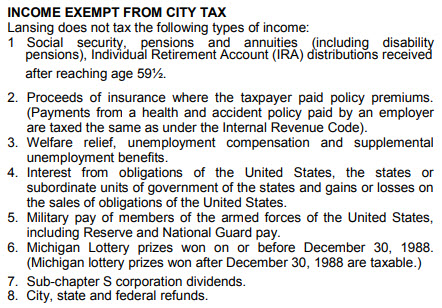
Brockschmidt says the BWL "tax" wouldn't be necessary if the City could increase its income tax. That is not possible because state law doesn't allow it. Of the 24 Michigan cities that have an income tax, only four have rates higher than 1%:
A rate over 1% can only be established through an act of the legislature.
The City Income Tax Act is Act 284 of 1964. It needs to be amended to allow Michigan cities to design and enact their own income taxes. It is a problem that needs to be solved by our state legislators.
Lansing's income tax brought in $42,184,295 in 2024 (source: Proposed Budget, page 38). The $26,237,421 payment it got from the BWL is about 60% of that, so we could replace the revenue from the BWL's so-called "return on equity" by increasing our income tax rate to 1.6%. Our taxes would go up, but our BWL bills would go down.
And if we chose to increase the rate a bit more, we'd have money for things like fixing our streets.
|