|
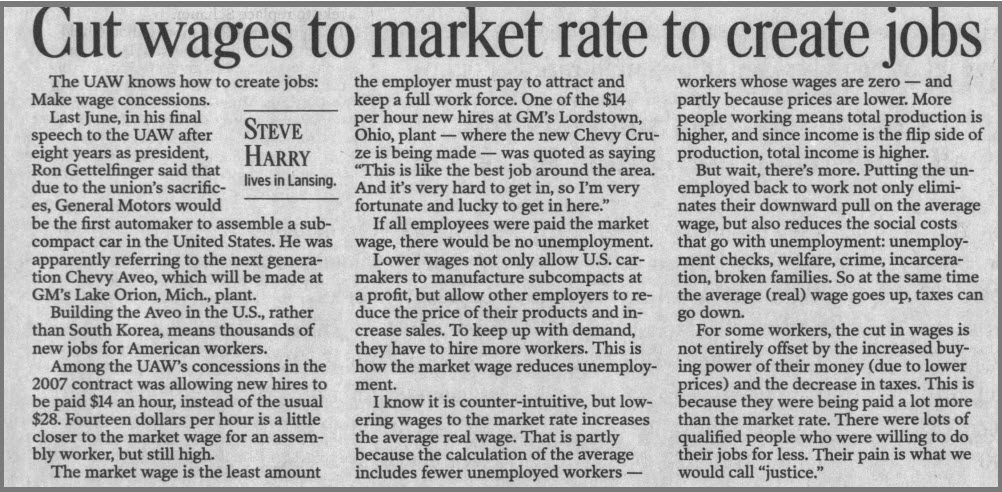
October 3, 2010 - Lansing State Journal

The 2012 Sonic LTZ hatchback (image stolen from
mlive.com)
Email exchange:
From:
Steve Harry [mailto:steve_harry@yahoo.com]
Sent: Monday, October 04, 2010 3:27 PM
To: Thompson, Chrissie
Cc: Bell, Dawson
Subject: New jobs at Lake Orion plant
Chrissie,
I just
read your September 23 article "Tiny Aveo a Big UAW Challenge" and I
have some questions you might be able to answer.
Seems
to me that building the Aveo in Michigan rather than Korea is a big
deal. It means that a lot of new jobs will be created. If the Aveo was
being manufactured elsewhere in the U.S. , or if it was replacing
another model manufactured here, or even competing with another model
manufactured here, the jobs created might have been offset by job losses
elsewhere, but that is not the case. These really are new jobs, and to
manufacture a whole new car, isn't it going to require, like,
thousands
of new jobs? So my first question is, How many jobs will be created? Has
anybody offered an estimate?
My
second question assumes that a lot of jobs will indeed be created: Why
isn't Governor Granholm making a big thing of it? New jobs - especially
when we are talking maybe
thousands
of new jobs - should be big news here in Michigan, right? Your article
says Bob King has some doubts as to whether the Aveo can be produced at
a profit. If it can only be produced at a profit by the UAW's $14 per
hour "third tier" workers, I can see why King isn't too excited about
it.
I had a
letter in the Lansing State Journal's Sunday edition on this subject.
You can see it at [link no longer works].
Steve
Harry
517-323-3897
From:
Chrissie Thompson
Sent: Monday, October 05, 2010 1:59 PM
To: Steve Harry
Cc: Bell, Dawson
Subject: Re: New jobs at Lake Orion plant
Hey, Steve. Did you see my story yesterday? [link no longer works] This
speaks to your last point about why people may not be making a big deal
about the Orion jobs…
GM still hasn’t said how many workers they’ll put in the Orion plant.
About 1,500 workers are on layoff there now.
-Chrissie Thompson
Reporter
Detroit Free Press
cthompson@freepress.com
Responses to my letter:
$14 an hour isn't high
October 12, 2010
I write in response to Steve Harry's astonishing Oct. 3 commentary,
claiming that the answer to creating jobs is to cut wages to some
mythical "market" level. He thinks that the UAW agreeing under
pressure to cut wages for new autoworkers from $28 to $14 an hour
was great, but adds that $14 is "still high." How can he be serious?
Fourteen dollars an hour is only $29,000 a year. That's barely above
the federal poverty level for a worker with a family! Meanwhile, the
average CEO compensation for the S&P 500 corporations - who've been
outsourcing our jobs by the millions - is $9.2 million per year.
That's more than $4,400 per hour.
In the 1960s, the average CEO earned 30 times the amount of the
average worker. Today, it is 300 times as much. Thirty years of
Reagan Republican "trickle-down" economics are destroying the middle
class.
Marty Kushler
Williamston
Wage claims ridiculous
October 19, 2010
Steve Harry (Forum, Oct. 3) is obviously a " trained economist" who
has the answers to all the problems we face. Or is he only mimicking
ravings of the far right? To blame auto workers and unions for these
problems, without even mentioning the gaffs of management and the
greed of corporations, is a good indication of his allegiances.
Admittedly, I am not an expert on economics, but it would be very
easy to find someone who could refute all of Harry's ideas. As a
retired auto worker, I am not ashamed of the wages I earned. It
allowed me to pay more than $260,000 in taxes, give to charity and
buy goods and services, etc. - all things that kept the economy
going strong. That is until the author of "trickle down and voodoo
economics," Ronald Reagan, came along and the age of corporate greed
began!
Steve Stavros
DeWitt
Cut from the top
November 3, 2010
First, it was the guy who penned a column in the LSJ to say that if
the union workers would take a 50 percent pay cut, it would solve
unemployment and fix the recession. (Except they didn't cause it.)
Then, Rick Snyder says he will cut state employees' wages and
benefits. Great idea - if he starts at the top with his pay and the
rest of the overpaid, part-time Legislature, its staff, the judges
and everybody else who is paid with tax dollars.
The
union workers and state employees didn't cause this mess. The
greedy, overpaid suits did.
I am
sure most of the union workers would take a pay cut if it would
bring back their coworkers. But, only if it started at the top. The
divide between workers' pay and the CEOs and board members' pay has
grown exponentially. There is no reason for a CEO to make 450 times
more than the average worker. They certainly don't work 450 times
harder.
Start cutting at the top and see how things improve.
Hugh
Dunlap
Dimondale
|